

The One Thing Missing From Modern Childhood
Modern childhood looks very different from the childhood many parents remember. Children today have access to more entertainment, more technology, more educational resources, and more carefully designed products than any generation before them. Their schedules are often filled with activities intended to support learning, development, and achievement. Homes are filled with digital devices, interactive toys, streaming platforms, and constant stimulation designed to capture attention immediately.
Yet despite all of these advancements, many parents, educators, and child development specialists are beginning to notice the same concern.
Children seem more overwhelmed than ever before.
Many children now struggle with:
- shorter attention spans
- emotional overwhelm
- difficulty managing boredom
- Reduced independent play
- constant need for stimulation
- frustration intolerance
- difficulty focusing deeply
- increased anxiety and restlessness
The issue is not necessarily that modern childhood contains too much technology or too many opportunities. The deeper concern is that something incredibly important has slowly disappeared in the process.
One of the most valuable parts of childhood — slow, imaginative, unstructured play — is becoming increasingly rare.
For many children today, there is very little space left for wandering imagination, boredom, quiet creativity, or self-directed exploration. Entertainment is almost always available instantly. A screen can fill silence within seconds. Structured activities often replace free afternoons. Toys are frequently designed to provide rapid stimulation instead of long-term imaginative engagement.
As a result, many children are growing up with fewer opportunities to develop the internal creativity, patience, emotional regulation, and concentration that slower forms of play naturally encourage.
Childhood Used to Be Slower
In previous generations, childhood often contained large amounts of unstructured time. Children spent hours outdoors, built forts from blankets and cushions, invented games with simple objects, and created imaginary worlds without instructions or supervision.
These experiences may have appeared ordinary from the outside, but they supported incredibly important developmental skills.
During open-ended play, children naturally practised:
- creativity
- storytelling
- problem-solving
- emotional regulation
- concentration
- social understanding
- resilience
- cognitive flexibility
Most importantly, children learned how to create engagement from within themselves.
They did not constantly rely on external stimulation to feel entertained.
Today, childhood often moves much faster. Modern environments are intentionally designed to hold attention continuously. Children are surrounded by flashing toys, fast-paced digital entertainment, constant notifications, bright visuals, and endless content designed to stimulate the brain rapidly.
While technology itself is not inherently harmful, the nervous system still requires slower experiences in order to develop balance.
Children’s brains are still learning how to:
- focus attention
- regulate emotions
- tolerate frustration
- process sensory information
- sustain concentration
- manage boredom
When stimulation never slows down, it becomes harder for children to practise these internal skills naturally.
The Disappearance of Boredom
One of the biggest differences between modern childhood and previous generations is the disappearance of boredom.
For many adults, boredom used to be unavoidable. There were moments of waiting, quietness, and unstructured time where children simply had to figure out what to do next. Those moments often became the starting point for creativity.
Today, boredom disappears almost immediately because entertainment is always accessible. If a child becomes restless, a screen, video, app, or highly stimulating toy can instantly fill the silence.
But boredom serves an important developmental purpose.
When children are not externally entertained, the brain begins searching internally for stimulation. That process is often where imagination begins.
A child with “nothing to do” may eventually:
- invent a game
- begin drawing
- build a fort
- create imaginary characters
- role-play adventures
- explore storytelling
- experiment creatively
Many of the richest childhood play experiences emerge only after boredom.
Without opportunities for boredom, children may struggle to develop the ability to generate ideas independently.

Imagination Is Becoming Replaced by Consumption
One major shift in modern childhood is the movement from creation towards consumption.
Children once spent large amounts of time creating:
- imaginary worlds
- stories
- games
- forts
- adventures
- role-play scenarios
Now many children spend more time consuming entertainment created by others.
This matters because imaginative play strengthens the brain differently from passive entertainment.
Imaginative play requires children to:
- invent narratives
- solve problems
- create meaning
- process emotions
- direct attention
- practise independent thinking
The child becomes the creator rather than the observer.
This internal mental activity is incredibly important for healthy cognitive and emotional development.
Why Independent Play Matters More Than Ever
Independent play is not simply about keeping children occupied.
It is one of the most important ways children develop confidence in their own creativity and ability to engage with the world independently.
During independent play, children learn how to:
- sustain focus
- explore ideas
- tolerate frustration
- solve problems
- regulate emotions
- build confidence
- engage deeply without constant external rewards
Unfortunately, modern childhood often leaves very little room for independent imaginative play.
Children move constantly between:
- school
- organised activities
- sports
- tutoring
- digital entertainment
- supervised routines
While structured activities provide valuable opportunities, children also need time where nothing specific is expected from them.
Unstructured play allows children to follow curiosity naturally instead of constantly responding to instructions, goals, or stimulation.
Why Modern Toys Often Make the Problem Worse
Interestingly, many modern toys contribute to overstimulation rather than imagination.
Toys today are frequently designed to:
- flash
- sing
- move automatically
- provide instant feedback
- direct the play experience
While these toys may create immediate excitement, they often leave very little room for creativity.
Once children discover everything the toy can do, the novelty fades quickly because the experience becomes repetitive.
By contrast, open-ended toys remain engaging because children continue reshaping the experience themselves.
A simple imaginative environment can become:
- a castle
- a cave
- a reading retreat
- a spaceship
- a pirate ship
- a secret hideaway
The environment stays the same, but the child’s imagination transforms the experience repeatedly.
This is one reason many families are now moving towards calmer, more flexible play environments instead of highly stimulating toy clutter.
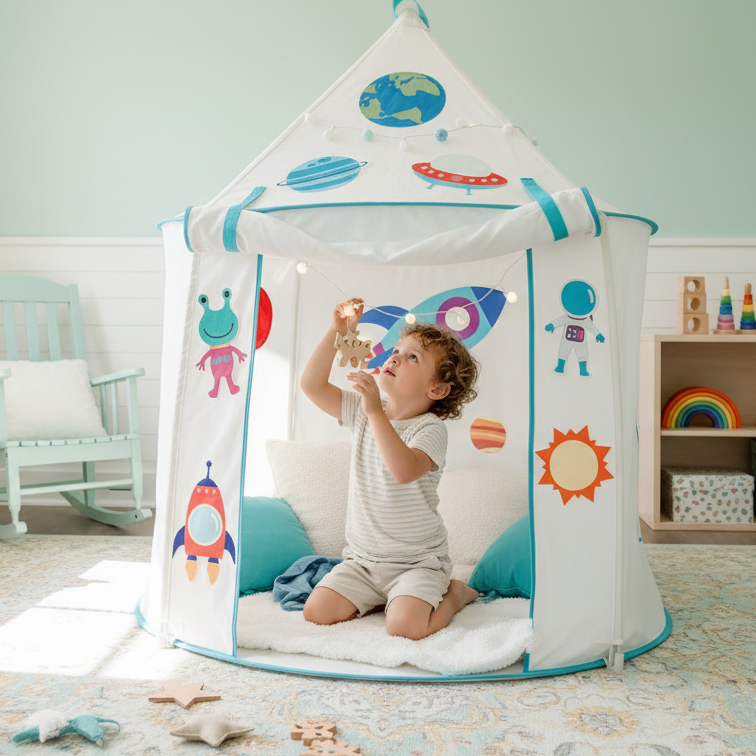
Flexible, imaginative spaces such as ZeeZee Adventures support this kind of deeper engagement naturally because they do not dictate how children should play. Instead, they provide a calm environment where imagination remains at the centre of the experience.
One day, the space becomes a quiet reading corner. The next day it transforms into an adventure camp, storytelling nook, or magical hideaway. The play evolves because the child’s creativity drives the experience.
Children Need Calm More Than Constant Stimulation
Modern childhood often assumes children always need more stimulation in order to stay engaged.
But research in child development increasingly suggests the opposite may be true.
Many children today are already overstimulated.
Constant exposure to:
- screens
- rapid entertainment
- loud toys
- crowded schedules
- endless visual input
can overwhelm developing nervous systems.
This may partly explain why many children now struggle with:
- emotional meltdowns
- irritability
- difficulty concentrating
- restlessness
- frustration tolerance
- poor independent focus
Calm environments help children slow down mentally and emotionally.
When children have access to quieter spaces and slower forms of play, they often:
- concentrate longer
- regulate emotions more effectively
- engage more creatively
- settle into deeper imaginative experiences
This is why cosy reading corners, forts, imaginative tents, and calm play spaces often become children’s favourite environments.
These spaces create emotional safety as well as imaginative freedom.
Childhood No Longer Contains Enough Quietness
Another major loss in modern childhood is quietness itself.
Many children now move constantly between stimulation sources without pauses for stillness or reflection.
Yet quiet play is often where deeper thinking develops.
Activities such as:
- reading
- drawing
- imaginative storytelling
- building
- crafting
- role-play
- independent exploration
encourage children to engage with their own thoughts instead of constantly reacting to external stimulation.
Quietness allows children to:
- process emotions
- develop concentration
- practise patience
- strengthen imagination
- think independently
Without enough quiet space, children may begin depending on constant entertainment simply to feel engaged.
The Importance of Safe Imaginative Spaces
Children often play most deeply in environments that feel emotionally safe and manageable.
Interestingly, children frequently engage better in smaller imaginative spaces than in large overstimulating playrooms.
A cosy environment can help children:
- focus attention
- reduce sensory overwhelm
- feel emotionally secure
- immerse themselves in storytelling
- play independently for longer periods
This is one reason forts, tents, reading nooks, and enclosed imaginative corners remain so appealing across generations.
Children feel as though they are stepping into a world of their own creation.
The environment itself becomes part of the story.
Parents Are Feeling the Pressure Too
Modern parenting often comes with enormous pressure to maximise every moment of childhood.
Parents are encouraged to:
- optimise learning
- schedule enrichment
- introduce educational technology
- keep children constantly occupied
- avoid boredom entirely
But children do not necessarily need more stimulation in order to thrive.
In many cases, they need less.
They need:
- slower afternoons
- quieter spaces
- fewer distractions
- opportunities for boredom
- imaginative freedom
- time to explore independently
Some of the most meaningful developmental experiences happen quietly and invisibly through play.
A Different Way to Think About Childhood
Perhaps the missing piece in modern childhood is not another educational app, another activity, or another highly stimulating toy.
Perhaps what children truly need most is space.
Space to:
- imagine
- create
- get bored
- explore
- think slowly
- invent stories
- build worlds from nothing
Because imagination cannot fully develop when every moment is filled for the child.
Children need opportunities to contribute their own ideas, stories, and creativity to the world around them.
And when children are finally given enough room for imagination to breathe, something remarkable happens.
They slow down.
They focus.
They create.
They begin building worlds of their own again.
Frequently Asked Questions
Why is imaginative play important for children?
Imaginative play supports creativity, emotional regulation, problem-solving, storytelling, and concentration. It allows children to actively shape their experiences rather than passively consume entertainment.
Why are children struggling with attention spans today?
Many experts believe constant stimulation from screens, fast-paced entertainment, and overstimulating environments can make it harder for children to develop sustained focus naturally.
Is boredom healthy for children?
Yes. Boredom encourages children to generate ideas internally, which often leads to creativity, independent thinking, and imaginative play.
Do children need fewer toys?
Research suggests children often engage more deeply when they have fewer, more intentional toys because excessive choices can overwhelm attention.
What kind of environments support deeper play?
Calm, cosy, open-ended environments that reduce overstimulation and encourage imagination usually support deeper independent play.
Why do children love forts and play tents?
Small imaginative spaces often create feelings of emotional safety and immersion, helping children focus and engage more deeply in storytelling and pretend play.
Can screens replace imaginative play?
While technology can support learning in some ways, it does not fully replace the developmental benefits of self-directed imaginative play.
How can parents encourage more imaginative play?
Parents can encourage imagination by creating calmer play environments, reducing overstimulation, allowing boredom occasionally, and providing open-ended materials and imaginative spaces.
- Baby Registry
- Baby Shower
- Best gifts
- best play tent
- Best toys
- Best toys 2026
- birthday gift ideas for 3 year old
- birthday gift ideas for 4 year old
- birthday gift ideas for 5 year old
- birthday gift ideas for 6 year old
- birthday gift ideas for 7 year old
- Blog
- calming toys
- child development
- children
- christmas gift ideas
- customizable play tent
- gift for kids ages 3–8
- Holidaygiftguide
- jeanpiaget
- kids play tent
- Montesoori
- montessori
- Montessori Gifts
- Montessori play
- open-endedplay
- openendedplay
- parenting
- parents
- play tent
- Play Tents
- playroom inspo
- pretend play
- sahm
- Sensory Play
- sensory play gifts
- teepee play tent
- toddler toys
- tonies
- toyclutter
- toys
- ZeeZee
- ZeeZee Adventure
- ZeeZee Adventure Tent
- ZeeZee Adventures





Comment (0)