

Why Imaginative Play Is Declining (And How to Bring It Back)
The Quiet Shift in Childhood
There was a time when play did not require instructions.
A child could sit with a few simple objects—a blanket, a box, a handful of figurines—and create entire worlds. A chair became a spaceship. A corner of the room transformed into a hidden cave. Stories unfolded naturally, without prompts or scripts.
Today, something has changed.
Many parents and educators have begun to notice a subtle but important shift in how children play. While children still engage with toys, the nature of that play often looks different.
It is faster.
More structured.
More dependent on external stimulation.
Imaginative play—the kind that allows children to invent, explore, and create freely—appears to be declining.
This shift is not caused by a single factor. It reflects a combination of environmental, technological, and cultural changes that have reshaped childhood in recent years.
Understanding why this is happening is the first step toward restoring something essential:
A child’s natural ability to imagine.
What Is Imaginative Play—and Why It Matters
Imaginative play, often called open-ended or pretend play, happens when children create their own narratives, roles, and worlds.
It is the kind of play where:
- objects become symbols
- environments transform into imagined spaces
- children invent stories instead of following them
A stick becomes a wand.
A cushion becomes a mountain.
A quiet space becomes an entire universe.
This type of play is not just entertainment—it is deeply developmental.
Research shows it supports:
- cognitive flexibility
- problem-solving
- language development
- emotional regulation
- social understanding
When children engage in imaginative play, they are not consuming experiences.
They are building them.
The Rise of Structured Play
One of the biggest shifts in childhood today is the rise of structured play.
Many modern toys are designed with predefined roles, instructions, and outcomes.
They often:
- guide children through specific actions
- tell a fixed story
- provide immediate feedback through lights, sounds, or screens
These features can make toys engaging at first.
But they also reduce the space for interpretation.
When a toy already defines what it is and how it should be used, the child has less room to imagine something new.
Over time, this limits opportunities for creative exploration.
The Impact of Digital Entertainment
Another major factor is the rise of digital media.
Screens offer fast-paced, highly stimulating experiences that require very little effort to engage with.
This changes the nature of play.
Instead of creating stories, children consume them.
Instead of building worlds, they explore pre-built ones.
Instead of imagining outcomes, they react to them.
While digital tools can be useful in moderation, excessive exposure reduces the time and mental space needed for imagination.
Because imagination depends on something many modern environments remove:
Pause.
Silence.
Boredom.
The Problem of Overstimulation
Modern play environments are often filled with sensory input:
Bright colors
Loud sounds
Constant movement
Visual clutter
While stimulation has its place, too much of it fragments attention.
Children move quickly from one stimulus to another without fully engaging with any of them.
Imaginative play, on the other hand, requires sustained attention.
It requires children to stay with an idea long enough for it to grow.
Why Time Matters More Than We Think
Another overlooked factor is time.
Many children today live highly structured lives filled with school, activities, and guided experiences.
While these are valuable, they often leave little room for unstructured play.
Imaginative play does not happen instantly.
It builds slowly.
A child may spend several minutes just setting up a story before it even begins.
Without time, depth disappears.
The Role of Boredom in Creativity
Boredom is often treated as something to fix.
But it is actually one of the most important triggers for imagination.
When children are not constantly entertained, their minds begin to search inward.
That’s when creativity starts.
A bored child doesn’t stay bored for long.
They invent.
They explore.
They imagine.
But when stimulation is always available, this process never begins.
The Decline of Open-Ended Environments
Another subtle shift is in the environments where children play.
Many spaces today are filled with toys, colors, and objects designed to capture attention.
But they often lack flexibility.
In contrast, environments that support imaginative play tend to include:
- open-ended materials
- calm visual backgrounds
- adaptable spaces
Spaces that do not tell children what to do—but invite them to decide.
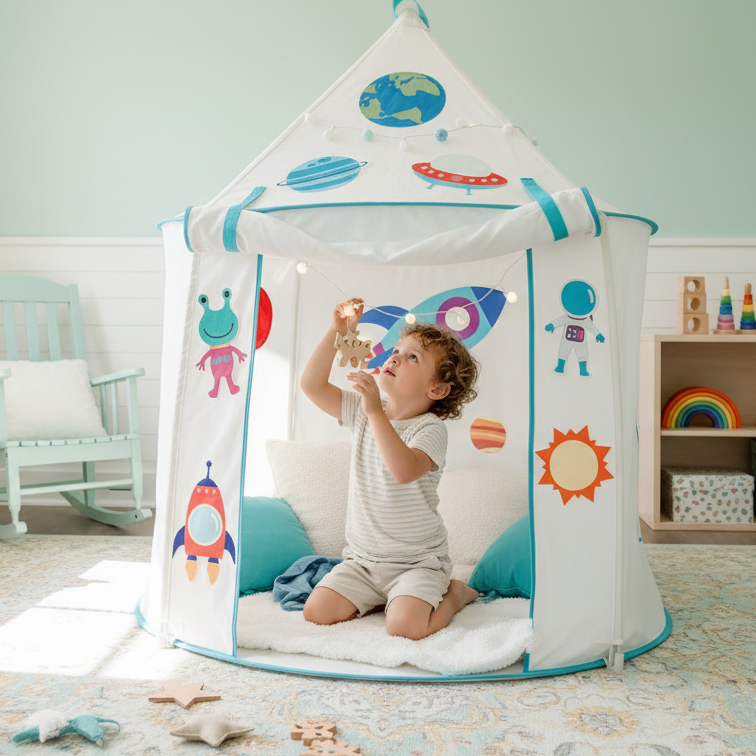
This is why some modern play approaches focus less on individual toys and more on flexible play environments—including modular setups or adaptable spaces like tent-based play areas (such as those explored in ZeeZee Adventures)—that children can continuously reinterpret in new ways.
Notice the difference:
The space doesn’t define the story.
The child does.
How to Bring Imaginative Play Back
Restoring imaginative play doesn’t require drastic change.
It requires intentional shifts.
1. Simplify the Environment
Fewer toys often lead to deeper engagement.
2. Choose Open-Ended Materials
Objects that can be used in multiple ways support creativity.
3. Create Calm Spaces
A quiet corner can be more powerful than a room full of stimulation.
4. Limit Passive Entertainment
Not eliminate—but balance.
5. Allow Unstructured Time
This is where imagination grows.
A Different Way to Think About Play
The decline of imaginative play is not inevitable.
It is a reflection of how environments and experiences have changed.
And that means it can be reversed.
Imagination does not require more.
It requires space.
Space to think.
Space to explore.
Space to create.
When children are given that space, something remarkable happens.
They return to what they do best.
They imagine.





Comment (0)