

Why Some Toys Get Ignored (And What Kids Actually Need Instead)
It often begins with excitement.
A new toy arrives at home, and for a while, it transforms the atmosphere completely. Curiosity takes over. The object becomes the center of attention, drawing the child into repeated interaction. Buttons are pressed, parts are explored, patterns are understood. The toy is examined from every angle, its possibilities tested again and again. During this phase, it feels essential—almost irreplaceable.
For a brief period, the toy seems to occupy a meaningful place in the child’s world.
Yet gradually, something shifts.
The intensity fades. The interactions become less frequent. What once invited exploration now feels familiar, predictable. The toy is used occasionally, then rarely, and eventually not at all. It remains present, but no longer active—absorbed into the background of the room alongside other objects that once held the same promise.
This pattern is so common that it is often accepted without question.
Many parents interpret it as a natural part of childhood. It is widely assumed that children simply lose interest quickly, that their attention spans are short, and that the solution lies in introducing something new. This belief has shaped an entire culture around play—one defined by cycles of purchase, brief engagement, and replacement.
But research in child development offers a more nuanced perspective.
The issue is not that children lose interest too easily.
It is that many toys are not designed to sustain interest over time.
The Hidden Limitation of Most Toys
To understand why engagement fades, it is necessary to look closely at how most toys are designed.
Conventional toys are typically built around a fixed purpose. Their structure defines their use. A puzzle is meant to be solved in a particular way. A musical toy follows a limited sequence of sounds or responses. A themed playset often comes with a predefined narrative, suggesting specific roles, characters, and outcomes.
These features can make a toy immediately engaging.
They provide clarity. They offer direction. They reduce uncertainty, allowing the child to quickly understand what the object is for and how it should be used.
But this clarity comes with a limitation.
Once a child has explored all the available interactions, the experience begins to feel complete.
There is little left to discover.
And without discovery, curiosity begins to fade.
This phenomenon is not a failure of attention. It is a predictable cognitive response.
Psychologists often describe it as novelty decline—the natural reduction in engagement that occurs when something becomes predictable. In early childhood, attention is closely tied to exploration. Children are not simply drawn to stimulation; they are driven by the opportunity to uncover something new.
When a toy no longer offers variation, challenge, or unpredictability, it loses its capacity to hold attention.
The child is not rejecting the toy.
They are responding to the absence of new possibilities.
The Cycle of Consumption and Disengagement
Over time, this dynamic creates a familiar pattern.
A new toy is introduced and generates excitement. It is explored intensively, often becoming a central part of play for a short period. Then, as its possibilities are exhausted, it gradually loses its appeal. It is replaced by another toy, which follows the same trajectory.
This cycle repeats itself across months and years.
The result is not only a growing collection of unused or underused toys, but also a pattern of shallow engagement. Play becomes fragmented, moving quickly from one object to another without sustained exploration.
More importantly, this cycle can limit opportunities for deeper forms of play—those that require time, imagination, and cognitive involvement.
When play experiences are brief and repetitive, they tend to remain surface-level. They entertain, but they do not always challenge or expand the child’s thinking in meaningful ways.
This raises an important question:
If more toys do not lead to better play, what does?
From Objects to Possibilities
The answer lies in shifting how we think about play itself.
Instead of focusing on what a toy does, it becomes more useful to consider what a child can do with it.
The toys and play experiences that sustain engagement over longer periods tend to share a fundamental characteristic:
They are not defined by a single outcome.
They invite interpretation rather than instruction.
Child development specialists often refer to these as open-ended play experiences—forms of play in which there is no single correct use and no fixed narrative. In these contexts, the value does not come from the features of the object, but from the possibilities it creates.
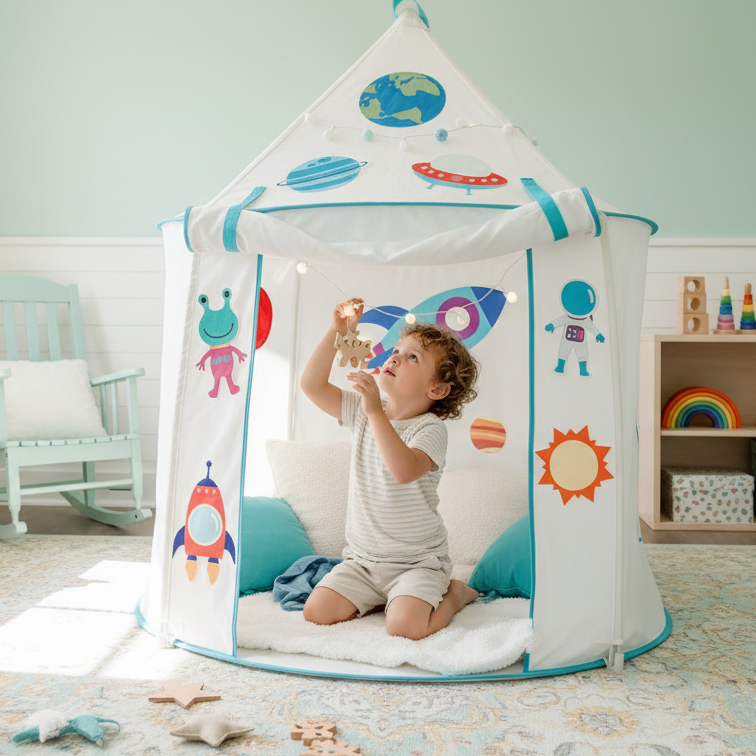
A simple structure can become many different things depending on how it is used. A space might serve as a castle one day, a spaceship the next, and a quiet retreat the day after that. Stories evolve, roles shift, and the meaning of the environment changes continuously.
Because the experience is not fixed, it does not reach a point of completion.
Instead, it remains open to reinterpretation.
This openness is what sustains engagement.
Imagination as an Active Process
When children engage in open-ended play, they are not simply interacting with an object.
They are actively constructing experiences.
They create narratives, assign roles, and explore relationships between characters and ideas. They test scenarios, experiment with outcomes, and adapt their play based on new inputs. This process requires continuous cognitive effort.
Unlike passive forms of entertainment, which rely on repetition or pre-defined responses, open-ended play demands creativity.
It requires the child to generate meaning rather than consume it.
Research consistently shows that this type of imaginative play contributes to a wide range of developmental outcomes. These include problem-solving skills, creative thinking, emotional regulation, and language development.
When children invent stories, they practice structuring ideas and expressing them coherently. When they take on different roles, they explore perspectives and social dynamics. When they encounter challenges within their play scenarios, they develop strategies to resolve them.
These processes are not separate from development.
They are central to it.
And importantly, they are sustained not by novelty, but by possibility.
The Role of Environment in Sustained Play
While much of the discussion around play focuses on toys, the environment in which play takes place is equally important.
The physical and sensory context can significantly influence how children engage with their surroundings.
Highly stimulating environments—filled with bright colors, constant noise, and an abundance of objects—can fragment attention. When multiple stimuli compete for focus, it becomes difficult for children to engage deeply with any one activity.
In contrast, calmer and more structured environments tend to support sustained engagement.
These environments are not empty, but they are intentional. They reduce unnecessary distractions and provide elements that can be used in flexible ways. They often include defined spaces that create a sense of separation from everyday activity.
This sense of separation is important.
When a space feels distinct, it becomes easier for children to enter an immersive state of play. The environment signals that something different is happening—that this is a place for exploration, imagination, or quiet focus.
Simple elements can be surprisingly effective in creating this kind of environment.
A small enclosed space, a soft corner, or a flexible structure can act as a foundation for imaginative scenarios. These elements do not dictate what the space is. Instead, they allow it to become whatever the child needs it to be.
In this sense, the environment becomes a canvas.
Why Fewer Choices Can Lead to Deeper Play
Another insight from developmental research challenges a common assumption: that more options lead to better engagement.
In reality, the opposite is often true.
When children are presented with a large number of toys, their attention tends to become divided. They move quickly from one object to another, sampling rather than exploring. The presence of many choices can create a kind of cognitive overload, making it difficult to focus.
When fewer options are available, a different pattern emerges.
Children spend more time with each object. They explore it in greater depth. They experiment with new ways of using it. They become more resourceful, finding creative possibilities within familiar materials.
This shift from quantity to quality has important implications.
It suggests that meaningful play does not depend on having more things.
It depends on having the right kind of opportunities.
Rethinking Play as a Designed Experience
Taken together, these insights point toward a broader shift in how play is understood.
Instead of viewing play as something that happens through individual toys, it becomes more accurate to think of it as an experience shaped by both objects and environments.
This perspective encourages a more intentional approach.
Rather than asking, “What toy should we buy next?” it becomes more useful to ask:
“What kind of play experience supports exploration, creativity, and focus?”
This question shifts the emphasis from consumption to design.
It invites consideration of how different elements—space, materials, structure—work together to support meaningful engagement.
In this context, emerging approaches to play design are beginning to reflect these principles. Concepts centered around adaptable environments, sometimes described as modular or flexible play systems, focus less on fixed functionality and more on evolving possibilities.
For instance, approaches like ZeeZee Adventures can be understood not as traditional toys, but as examples of environments designed to support open-ended play. Rather than offering a single predefined experience, such systems function as adaptable spaces that can change alongside the child’s interests.
The significance of this approach lies not in the object itself, but in the shift it represents.
It reflects a growing recognition that play is most meaningful when it remains unfinished.
Play That Evolves Over Time
One of the defining characteristics of open-ended environments is their ability to grow with the child.
Traditional toys are often tied to specific developmental stages. They are designed for a particular age range, with features that align with certain skills or interests. As the child develops, these toys can quickly become less relevant.
In contrast, flexible play environments are not limited in the same way.
They do not depend on a specific narrative or function. Instead, they provide a framework within which different types of play can occur. As the child’s interests evolve, the way the environment is used evolves as well.
A space that once supported imaginative role-play may later become a place for reading, reflection, or creative projects. The structure remains the same, but its meaning changes.
This adaptability allows play to remain engaging over longer periods.
It reduces the need for constant replacement and supports a more sustainable approach to play.
The Emotional Dimension of Play Spaces
Beyond cognitive engagement, play environments also influence how children feel.
Spaces that are calm, contained, and thoughtfully designed can provide a sense of security. They can reduce sensory overload and create conditions that support emotional regulation.
In a world where children are often exposed to constant stimulation—from screens, noise, and busy environments—these qualities become increasingly important.
A well-designed play space can offer balance.
It can provide a place where children can both explore and unwind, where they can engage actively or retreat when needed.
This emotional dimension is often overlooked, but it plays a crucial role in how children experience play.
When a space feels safe and comfortable, it becomes easier for children to engage deeply. They are more likely to sustain attention, develop ideas, and return to the experience over time.
Toward a More Intentional Future of Play
The way we think about toys and play is gradually evolving.
There is increasing awareness that more is not always better, that stimulation alone does not guarantee engagement, and that meaningful play depends on deeper factors—flexibility, adaptability, and imagination.
Parents and educators are beginning to prioritize environments that support these qualities. They are looking for ways to reduce clutter, simplify spaces, and create opportunities for sustained exploration.
This shift reflects a broader change in perspective.
Play is no longer seen simply as a way to pass time.
It is recognized as a fundamental process through which children learn, create, and make sense of the world.
When Play Remains Unfinished
The toys that are most often abandoned are not necessarily lacking in quality or appeal.
They are simply complete.
They offer an experience with a clear beginning and end. Once that experience has been fully explored, there is little reason to return to it.
In contrast, the most engaging play experiences remain unfinished.
They do not resolve into a final state.
They continue to evolve, inviting new interpretations and new forms of interaction.
A simple space can illustrate this clearly.
On one day, it may become a castle filled with imagined characters and stories. On another, it transforms into a spaceship, launching into a completely different narrative. Later, it may serve as a quiet reading area, supporting a more reflective form of engagement.
The underlying structure does not change.
But the experience does.
And that is what sustains interest.
Conclusion: From Temporary Engagement to Lasting Exploration
Children do not need an endless stream of new toys to remain engaged.
They need opportunities.
Opportunities to explore, to imagine, to create, and to reinterpret their surroundings.
When play is open-ended, flexible, and shaped by the child, it becomes something more than a temporary activity.
It becomes a process of discovery.
A process that adapts, evolves, and grows alongside them.
And in that process, something important happens.
Interest does not fade.
It deepens.
- Blog
- calming toys
- child development
- children
- Holidaygiftguide
- jeanpiaget
- kids play tent
- Montesoori
- montessori
- Montessori Gifts
- Montessori play
- open-endedplay
- openendedplay
- parenting
- parents
- play tent
- Play Tents
- playroom inspo
- pretend play
- sahm
- Sensory Play
- sensory play gifts
- teepee play tent
- toddler toys
- tonies
- toyclutter
- toys
- ZeeZee
- ZeeZee Adventure
- ZeeZee Adventure Tent
- ZeeZee Adventures




Comment (0)