
Why Imaginative Play Matters More Than Ever
Quick Answer
Imaginative play is far more than simple make-believe. When children invent stories, create imaginary worlds, and pretend to be someone or something else, they develop creativity, problem-solving, emotional regulation, communication, and executive functioning skills that support lifelong learning. In today's increasingly screen-filled and highly structured world, opportunities for imaginative play have become more valuable than ever because they encourage children to think independently, adapt to new situations, and build confidence through self-directed exploration.
Introduction
Watch a young child pick up a cardboard tube.
To an adult, it's exactly what it appears to be.
A cardboard tube.
Nothing more.
But ask a child.
Suddenly it's a telescope searching for pirates across the ocean.
A magic wand capable of freezing dragons.
A microphone for a sold-out concert.
A pirate's spyglass.
Or the engine control lever of a spaceship heading toward an unexplored planet.
The object never changed.
Only the imagination did.
This remarkable ability to transform ordinary objects into extraordinary adventures is one of childhood's greatest strengths.
Children don't need expensive toys to imagine.
They don't need elaborate instructions.
They don't need adults to write the story.
Given the freedom to explore, they naturally create worlds filled with curiosity, possibility, and wonder.
Yet despite being one of the most important parts of healthy childhood development, imaginative play is becoming increasingly rare.
Many children today spend more time following instructions than inventing their own ideas.
Schedules are fuller.
Screens are everywhere.
Activities often have predetermined goals, rules, and outcomes.
Even play can begin to feel structured.
As adults, we naturally want to provide children with opportunities to learn.
But in our efforts to teach, organize, and entertain, we sometimes overlook one of the most powerful learning tools children already possess:
Their imagination.
When children pretend, they're doing much more than passing the time.
They're experimenting.
Questioning.
Problem-solving.
Practicing conversations.
Working through emotions.
Testing ideas.
Building confidence.
And preparing themselves for challenges they haven't even encountered yet.
As a pediatric occupational therapist, I've seen countless children reveal abilities during imaginative play that rarely emerge during more structured activities.
A child who struggles to participate in classroom discussions may confidently lead an imaginary expedition through a jungle.
Another who finds transitions difficult might happily spend an hour creating stories with toy animals.
A quiet child may suddenly become an enthusiastic storyteller.
Pretend play provides something unique.
It gives children ownership.
There are no right answers.
No grades.
No instructions to follow.
Only possibilities waiting to be discovered.
In this article, we'll explore why imaginative play has always been important—and why, in today's fast-paced, technology-driven world, it may be more essential than ever for raising creative, confident, emotionally resilient children.
What Is Imaginative Play?
Imaginative play, sometimes called pretend play, make-believe play, or dramatic play—happens whenever children create stories, roles, or situations that exist primarily in their imagination.
Instead of interacting only with what's physically in front of them, children begin exploring what could exist.
A blanket becomes a superhero cape.
A sofa becomes a pirate ship.
A stick transforms into a wizard's staff.
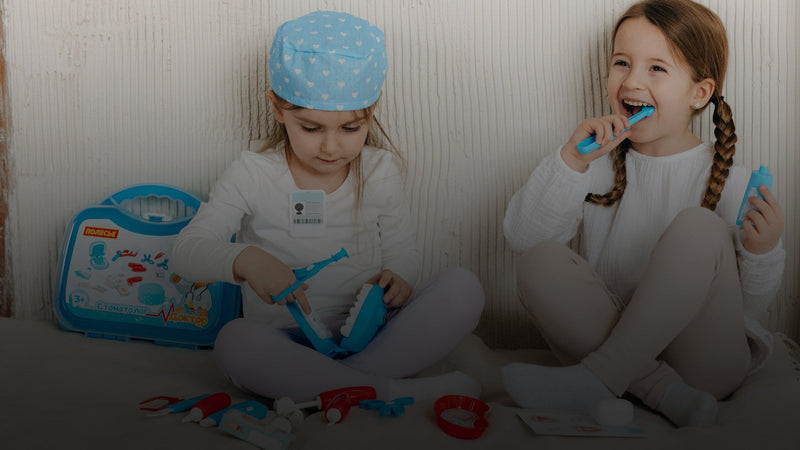
Stuffed animals open a veterinary clinic.
Toy dinosaurs become teachers.
The living room becomes another world entirely.
Unlike games with fixed rules or toys designed for one specific purpose, imaginative play has no predetermined outcome.
Children decide:
-
Who they want to be.
-
What story they're telling.
-
What challenges they'll face.
-
How those challenges will be solved.
Every decision comes from the child.
That's what makes imaginative play such a powerful learning experience.
Rather than consuming someone else's story, children become the author, director, actor, and problem-solver all at once.
This process strengthens far more than creativity.
It supports language development, flexible thinking, planning, emotional understanding, and independent decision-making—all while children believe they're simply having fun.
Expert Insight
Occupational therapists often view imaginative play as one of childhood's richest learning environments because it combines movement, language, social interaction, emotional processing, and creative thinking into a single activity. Through pretend play, children naturally practice many of the cognitive, emotional, and social skills they'll use throughout their lives.
Why Children Naturally Imagine
Children don't need lessons on how to imagine.
They're born with an incredible curiosity about the world.
From an early age, they begin asking questions that adults often overlook.
"What if animals could talk?"
"Could dinosaurs live on the moon?"
"What happens inside a cloud?"
"Can I build a house for my teddy?"
These questions aren't distractions from learning.
They are learning.
Imagination allows children to explore possibilities long before they fully understand reality.
It's how they make sense of new experiences, experiment with ideas, and safely test different roles.
A child pretending to be a firefighter isn't just copying what they've seen.
They're exploring courage.
Responsibility.
Helping others.
A child hosting a pretend tea party isn't merely arranging cups.
They're practicing communication, turn-taking, empathy, and storytelling.
Through imagination, children rehearse life in ways that feel playful rather than pressured.
Unlike adults, children don't separate learning from play.
To them, they're the same thing.
One imaginary adventure can include:
-
Planning.
-
Negotiating.
-
Building.
-
Listening.
-
Adapting.
-
Remembering.
-
Creating.
-
Problem-solving.
All without worksheets, lectures, or formal instruction.
This is why childhood experts often describe play as the natural language of children.
It's how they think.
It's how they express themselves.
And it's how they begin understanding both the world around them and their place within it.
Why Imaginative Play Is Becoming Less Common
If imagination comes so naturally to children, why does it sometimes seem harder to find today?
The answer isn't that children have changed.
Their curiosity is still there.
Their creativity is still there.
What's changed is the environment surrounding them.
Many children now grow up in a world that offers constant stimulation.
Television.
Streaming services.
Apps.
Video games.
Interactive toys.
Busy schedules filled with lessons, sports, tutoring, and organized activities.
None of these experiences are inherently negative.
But together, they leave less room for something essential:
Unstructured time.
Imaginative play thrives in moments when children are free to decide what happens next.
When every activity already has a script, children have fewer opportunities to invent one themselves.
It's also common for boredom to be seen as a problem that needs solving immediately.
Yet boredom is often where imagination begins.
Without instant entertainment, children start asking themselves questions.
"What could I build?"
"Who could I pretend to be?"
"What story could happen next?"
Those questions are the spark of creative thinking.
Protecting time for imaginative play isn't about rejecting technology or structured learning.
It's about making sure children still have regular opportunities to create instead of simply consuming.
In a world filled with ready-made entertainment, the ability to invent something entirely your own has become one of childhood's most valuable skills.
The Benefits of Imaginative Play
When children pretend to run a restaurant, rescue dragons, sail across imaginary oceans, or build cities from blocks, they aren't simply passing the time.
They're developing skills that support learning far beyond childhood.
Unlike activities with one correct answer, imaginative play requires children to think flexibly, adapt to changing situations, communicate ideas, and solve problems as they arise.
Every new story becomes an opportunity to practice life.
As a pediatric occupational therapist, I often remind parents that children don't learn these abilities through worksheets alone.
They develop them through meaningful experiences.
And few experiences are as rich as imaginative play.
Let's explore some of the most important developmental benefits.
1. Imaginative Play Builds Creativity
Creativity isn't something reserved for artists, musicians, or inventors.
It's the ability to generate ideas, approach challenges from different perspectives, and imagine possibilities that don't yet exist.
Every time children invent a new story, they're strengthening this ability.
A blanket isn't just a blanket.
It's a cave.
A sail.
A superhero cape.
A waterfall.
A dragon's wing.
The object remains exactly the same.
The child's thinking changes.
This process is known as divergent thinking—the ability to produce multiple solutions to a single problem.
Rather than asking,
"What's the right answer?"
Children begin asking,
"What else could this become?"
That question lies at the heart of creativity.
As children grow, this flexible way of thinking supports innovation in every area of life—from writing and science to engineering, entrepreneurship, and everyday problem-solving.
Creativity isn't about producing perfect ideas.
It's about feeling confident enough to explore new ones.
Imaginative play gives children that opportunity every single day.
Expert Insight
Research consistently shows that children who engage in imaginative, open-ended play have more opportunities to practice flexible thinking and idea generation. These experiences help build the creative problem-solving skills that remain valuable throughout school, work, and everyday life.
2. Pretend Play Strengthens Language and Communication
Listen to children playing together for just a few minutes.
You'll hear something remarkable.
They're negotiating.
Explaining.
Questioning.
Persuading.
Storytelling.
Inventing dialogue.
Changing characters.
Expanding ideas.
Pretend play naturally encourages children to use language for meaningful purposes.
A child pretending to be a veterinarian might explain how to care for an injured puppy.
Another playing restaurant may welcome customers, describe the menu, and solve unexpected problems when the "kitchen" runs out of imaginary pizza.
These conversations require far more than vocabulary.
Children learn to:
-
Express ideas clearly.
-
Listen to others.
-
Build conversations.
-
Ask thoughtful questions.
-
Understand different perspectives.
-
Tell complete stories with a beginning, middle, and end.
Even children playing alone often narrate their adventures aloud, strengthening expressive language while organizing their thoughts.
The stories may sound playful.
But the communication skills they're developing are very real.
3. Imaginative Play Develops Executive Function Skills
Executive function refers to the mental skills that help us plan, focus, remember information, adapt, and manage our behavior.
These abilities are essential for everything from completing homework to managing responsibilities as adults.
During imaginative play, children practice executive functioning almost constantly.
Imagine a child building a pirate ship from cushions.
They first imagine the finished result.
Then they gather materials.
They adjust their plan when cushions fall over.
They remember which blanket became the sail.
They switch roles from pirate captain to explorer.
Every step requires planning, working memory, self-control, and flexible thinking.
Unlike structured activities where adults provide instructions, imaginative play asks children to become the planners.
They're making decisions from beginning to end.
This kind of independent thinking strengthens the brain's ability to organize, adapt, and solve increasingly complex problems over time.
4. Imaginative Play Helps Children Understand Their Emotions
Children often process experiences through play long before they can explain them with words.
A child nervous about visiting the doctor may spend the afternoon treating stuffed animals.
Another adjusting to a new sibling might pretend to care for baby dolls.
A child working through disappointment may create stories where characters overcome challenges.
To adults, these games can seem simple.
To children, they're meaningful emotional rehearsals.
Pretend play provides a safe environment where children can explore big feelings without facing real-world consequences.
They can:
-
Practice bravery.
-
Experience frustration.
-
Solve conflicts.
-
Comfort others.
-
Explore empathy.
-
Build resilience.
Because the situations are imaginary, children remain in control.
That sense of control helps them gradually understand emotions that might otherwise feel overwhelming.
Expert Insight
Play is one of the ways children naturally process experiences and practice emotional regulation. Through make-believe, they can safely explore different feelings, relationships, and challenges while developing empathy and resilience.
5. Imaginative Play Builds Confidence Through Independence
One of the most powerful aspects of imaginative play is that adults don't have all the answers.
There isn't a correct script.
No one tells children exactly how the story should unfold.
They're in charge.
That ownership builds confidence.
When children decide:
-
what happens next,
-
who the characters are,
-
how problems will be solved,
-
and how the adventure ends,
they begin trusting their own ideas.
Every successful decision reinforces an important message:
"I can figure things out."
Confidence built through play often transfers into other areas of life.
Children become more willing to:
-
Try new activities.
-
Share ideas.
-
Take healthy risks.
-
Learn from mistakes.
-
Persist through challenges.
Rather than relying on constant adult direction, they begin believing in their own ability to create solutions.
6. Imaginative Play Encourages Social Skills
Whether children are pretending with siblings, friends, or parents, imaginative play is full of social learning.
Unlike games with fixed rules, pretend play requires children to build the rules together.
That means learning to:
-
Cooperate.
-
Compromise.
-
Take turns.
-
Negotiate roles.
-
Resolve disagreements.
-
Respect different ideas.
Imagine two children pretending to run a bakery.
One wants to bake cupcakes.
The other wants to sell pizza.
Together, they negotiate.
Maybe the bakery now serves both.
That small conversation is actually a lesson in collaboration.
Throughout childhood, these experiences help children understand that successful relationships require flexibility, communication, and empathy.
They're learning to work with others—not because an adult told them to, but because the story depends on it.
7. Imaginative Play Helps Children Become Better Problem-Solvers
Every imaginative adventure contains unexpected obstacles.
The bridge collapses.
The dragon escapes.
The pretend customers order something that's not on the menu.
The spaceship runs out of fuel halfway to the moon.
Unlike pre-programmed toys that often provide immediate feedback or predetermined outcomes, imaginative play encourages children to pause and think.
They ask themselves:
"What should happen next?"
"How can I fix this?"
"What else could I try?"
These moments develop flexible problem-solving skills that extend far beyond playtime.
Children become more comfortable experimenting with different solutions instead of expecting one perfect answer.
Over time, they learn that mistakes aren't failures.
They're simply opportunities to adapt.
That mindset supports resilience in school, friendships, and everyday life.
Why These Skills Matter Together
Each of these benefits is valuable on its own.
But the true power of imaginative play lies in how these skills develop simultaneously.
A single pretend adventure might require a child to:
-
Invent a story (creativity).
-
Explain it to a friend (communication).
-
Remember different character roles (working memory).
-
Adjust when the story changes (cognitive flexibility).
-
Solve unexpected challenges (problem-solving).
-
Comfort a frightened stuffed animal (empathy).
-
Stay engaged for an extended period (attention).
-
Celebrate an original idea (confidence).
Very few childhood activities combine so many areas of development at once.
And perhaps the best part?
Children don't see it as learning.
To them, it's simply play.
Helping Children Build a Lifetime of Imagination
The encouraging news is that supporting imaginative play doesn't require expensive toys, elaborate playrooms, or carefully planned activities.
In fact, the most meaningful imaginative experiences often begin with the simplest materials—and with adults who are willing to step back.
Children don't need us to create every adventure.
They need us to create the conditions where adventures can naturally unfold.
Here are a few practical ways to encourage imaginative play every day.
Leave Time That Isn't Planned
Many children move from one scheduled activity to another.
School.
Homework.
Sports.
Music lessons.
Family commitments.
By the end of the day, there may be very little time left for children to simply wonder.
Imaginative play needs breathing room.
It often begins slowly.
A child may wander around for several minutes before deciding what to play.
Resist the urge to immediately suggest an activity.
Those quiet moments of "I don't know what to do" are often the beginning of remarkable creativity.
Choose Toys That Invite Ideas
Not every toy needs flashing lights, sound effects, or a single intended purpose.
Children benefit most from materials that can become many different things.
Examples include:
-
Wooden blocks
-
Scarves and fabric pieces
-
Cardboard boxes
-
Toy animals
-
Loose parts
-
Art supplies
-
Building materials
-
Blankets
-
Natural objects like sticks, stones, and leaves
The fewer instructions a toy provides, the more opportunities children have to invent their own.
Follow Your Child's Story
Adults naturally want to help.
We explain.
Correct.
Improve.
Suggest.
But during imaginative play, children benefit most when adults become curious instead of directing.
Rather than saying,
"No, dinosaurs don't live in castles."
Try asking,
"Tell me what happens next."
Simple questions encourage children to expand their thinking while reinforcing that their ideas matter.
Some helpful prompts include:
-
"Who lives here?"
-
"What problem are they trying to solve?"
-
"How did that happen?"
-
"What do you think they'll do next?"
These questions extend imagination without taking control of the story.
Welcome a Little Mess
Imagination rarely stays perfectly organized.
Blankets become mountains.
Cushions become pirate ships.
Blocks spread across the floor as entire cities take shape.
While routines and tidying are important, allowing children enough space to fully develop an idea communicates that their creativity is valued.
Not every masterpiece needs to disappear before dinner.
Sometimes tomorrow's adventure begins where today's ended.
Protect Screen-Free Moments
Digital technology has become part of everyday life, and it offers many opportunities for learning and connection.
But imaginative play offers something screens cannot:
Children become the creators rather than the audience.
On a screen, someone else designs the characters, builds the world, and decides what happens next.
During imaginative play, children make those decisions themselves.
Finding a healthy balance between digital experiences and screen-free play helps ensure children continue developing the creativity, independence, and flexible thinking that emerge when they are free to invent their own worlds.
Expert Insight
One of the greatest gifts adults can give children isn't another activity—it's uninterrupted time to imagine. Creativity often flourishes when children have the freedom to explore ideas without constant instruction, correction, or entertainment.
Creating Spaces That Grow With a Child's Imagination
Children's interests change constantly.
One week they're fascinated by dinosaurs.
The next they're opening an imaginary bakery.
Soon after, they're astronauts exploring distant planets.
A play environment doesn't have to change completely every time those interests evolve.
Instead, it can provide a flexible foundation that supports whatever story children want to tell.
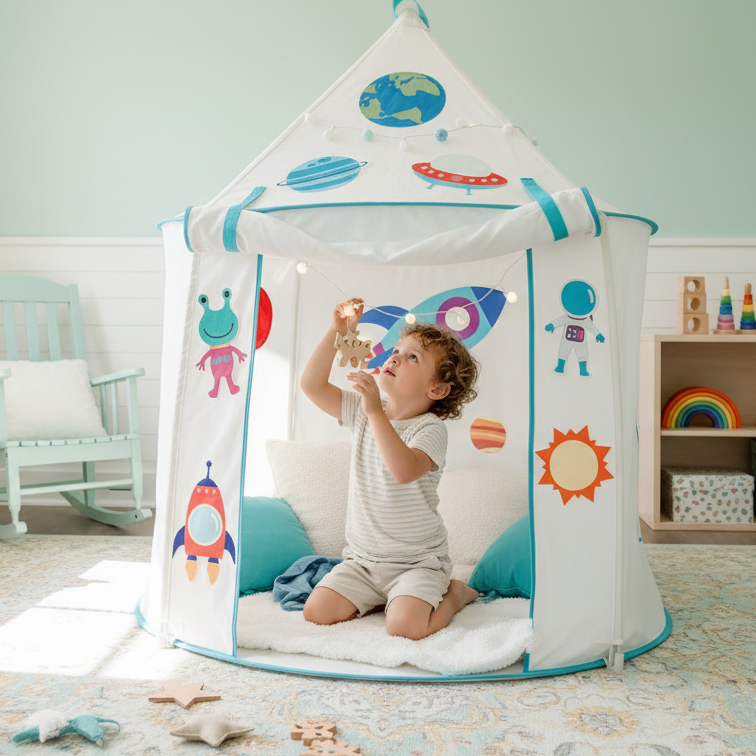
This philosophy is at the heart of ZeeZee Adventures. Rather than encouraging one fixed type of play, ZeeZee was designed as an adaptable imaginative environment that grows alongside children's changing interests. With interchangeable StickeeZ themes—from outer space and underwater adventures to magical kingdoms and prehistoric worlds—the same familiar play space can become countless different settings for child-led storytelling. By allowing children to transform their environment again and again, adaptable play spaces encourage longer periods of creative, independent, and screen-free play while keeping imagination at the center of every adventure.
Whether that imaginative world begins inside a play tent, beneath a blanket fort, or in the corner of a living room is far less important than what happens within it.
The greatest adventures don't come from the environment itself.
They come from the child who imagines what it could become.

Everyday Imaginative Play Ideas
One of the greatest strengths of imaginative play is that it doesn't require special equipment or a carefully planned activity.
Children are naturally imaginative.
Often, all they need is a little time, a few open-ended materials, and permission to take the lead.
Here are some simple ways to encourage imaginative play at home.
Turn Everyday Objects Into Adventures
Household items often inspire richer play than highly specialized toys.
Try collecting a basket filled with:
-
Cardboard boxes
-
Paper towel tubes
-
Wooden spoons
-
Scarves
-
Blankets
-
Empty containers
-
Fabric scraps
-
Clothespins
-
Cushions
Instead of suggesting what each item should become, simply ask:
"What could you make today?"
You might be surprised by the answer.
Create Story Starters
Sometimes children benefit from a small invitation to begin.
Try prompts like:
-
"A mysterious package arrives at your house…"
-
"Your teddy bear wakes up and starts talking…"
-
"You've discovered a hidden island…"
-
"A tiny dragon needs your help…"
-
"You can invent a brand-new animal. What is it like?"
Once the story begins, let your child take control.
Build Pretend Worlds Together
Create simple environments using items you already have.
Examples include:
-
A grocery store
-
A doctor's clinic
-
A bakery
-
A spaceship
-
A jungle
-
A castle
-
A campsite
-
A zoo
-
A museum
-
A train station
Remember, the goal isn't realism.
It's imagination.
Read a Story—Then Keep Playing
Books naturally inspire pretend play.
After reading together, ask:
-
"What happened after the story ended?"
-
"Could you visit that world?"
-
"What would your character do there?"
-
"Can we build that place together?"
Reading becomes the beginning of the adventure rather than the end.
Let Boredom Do Some of the Work
Parents often feel pressure to fill every quiet moment.
But boredom isn't the opposite of learning.
It's often the starting point for imagination.
When children aren't immediately entertained, they begin inventing.
That process may look slow at first.
Give it time.
The best ideas often appear a few minutes after children say,
"I'm bored."
Myth vs. Fact
|
Myth |
Fact |
|
Imaginative play is just for fun. |
It supports creativity, language, executive function, emotional regulation, and problem-solving. |
|
Children outgrow pretend play quickly. |
Imaginative thinking continues to evolve throughout childhood and supports lifelong learning. |
|
Expensive toys create better imaginative play. |
Simple, versatile materials often encourage far richer creativity. |
|
Adults should lead pretend play. |
Children benefit most when adults support rather than direct the story. |
|
Screen-based entertainment replaces imaginative play. |
Digital experiences and imaginative play develop different skills. Children benefit from having regular opportunities to create their own stories. |
Action Checklist
Small changes can make a big difference.
Use this checklist to encourage more imaginative play at home.
✅ Protect time for unstructured, child-led play each day.
✅ Keep open-ended materials within easy reach.
✅ Encourage storytelling instead of giving instructions.
✅ Choose toys that can be used in multiple ways.
✅ Read books that inspire imaginative adventures.
✅ Create cozy spaces where children feel comfortable exploring ideas.
✅ Allow children to leave unfinished creations and return later.
✅ Ask open-ended questions instead of providing answers.
✅ Balance screen time with opportunities for creative play.
✅ Celebrate imagination rather than focusing on perfect outcomes.
Remember:
Children don't need adults to write better stories.
They need adults who believe their stories are worth telling.
Frequently Asked Questions
Why is imaginative play important?
Imaginative play helps children develop creativity, communication, confidence, emotional understanding, executive functioning, and problem-solving skills. These abilities support learning, relationships, and resilience throughout life.
At what age does imaginative play begin?
Simple pretend play often begins between 18 and 24 months, becoming increasingly complex during the preschool years. However, imaginative thinking continues to grow throughout childhood.
What's the difference between imaginative play and open-ended play?
Imaginative play involves creating stories, roles, and imaginary situations.
Open-ended play refers to activities with no fixed outcome.
The two often overlap because open-ended materials naturally encourage imaginative storytelling.
Can imaginative play help with language development?
Yes.
Pretend play encourages children to describe ideas, create dialogue, tell stories, ask questions, and practice conversations, all of which strengthen expressive and receptive language skills.
How much imaginative play does my child need?
There isn't a single recommended amount.
Instead of focusing on minutes, aim to provide regular opportunities for uninterrupted, child-led play throughout the week.
Even short periods of meaningful imaginative play can have lasting developmental benefits.
My child prefers structured activities. Should I be concerned?
Not necessarily.
Every child has unique interests and preferences.
The goal isn't to eliminate structured activities but to make sure children also have opportunities to explore ideas without predetermined rules or outcomes.
Over time, many children become more comfortable leading their own play when they're given consistent opportunities to do so.
Final Thoughts
The world children are growing up in has changed dramatically.
Information is available instantly.
Entertainment is always within reach.
Schedules are fuller than ever.
Yet one of childhood's most valuable abilities remains exactly the same.
The ability to imagine.
Imagination allows children to see possibilities where adults see ordinary objects.
It encourages them to ask questions instead of waiting for answers.
It teaches them to experiment, adapt, and create rather than simply consume.
These aren't skills that disappear when childhood ends.
They become the foundation for innovation, resilience, empathy, and lifelong learning.
As parents, we don't need to create elaborate adventures every day.
We simply need to protect the time and space where children can create their own.
Whether it's a blanket fort in the living room, a cardboard spaceship in the backyard, or an imaginary bakery built from wooden blocks, those moments matter.
Not because of what children build.
But because of who they become while building it.
So the next time your child turns a cardboard box into a rocket or a scarf into a superhero cape, remember:
They're not "just pretending."
They're practicing the creativity, confidence, and curiosity they'll carry with them for the rest of their lives.
And in a world that increasingly provides ready-made answers, raising a child who can imagine new possibilities may be one of the greatest gifts we can give.





Comment (0)