
The No Phone Summer Movement: How Families Are Reclaiming Childhood Through Screen-Free Independent Play for Kids
Introduction
If you've spent any time on parenting forums, social media, or school parent groups lately, you've probably noticed a growing trend: the "No Phone Summer."
Across the country, more families are choosing to put smartphones, tablets, and endless scrolling on pause during the summer months. The movement isn't about rejecting technology entirely. Instead, it's about helping children reconnect with something many parents feel has been quietly disappearing—an authentic childhood filled with imagination, curiosity, and real-world play.
The timing isn't surprising. With updated screen time recommendations and growing awareness of how constant digital stimulation affects attention, sleep, and emotional regulation, many parents are searching for practical ways to create a healthier balance. Yet there's one major challenge: removing screens is often easier than replacing them.
Children who are accustomed to constant entertainment can quickly become frustrated, restless, or bored when devices disappear.
That's where the concept of the analog childhood comes in.
Rather than filling every moment with activities, lessons, or digital distractions, an analog childhood creates space for imagination, independent exploration, and open-ended play. The goal isn't to entertain children every second of the day—it's to help them rediscover how to entertain themselves.

The Core Problem: Why Modern Entertainment Often Leaves Kids Wanting More
Many parents assume boredom is the problem.
In reality, the bigger issue is often overstimulation.
Today's children are surrounded by flashing lights, rapid scene changes, instant rewards, and toys that do most of the playing for them. Whether it's a tablet game, a video platform, or a battery-powered toy packed with sounds and buttons, many forms of entertainment provide constant input.
The brain naturally adapts to this level of stimulation.
As a result, quieter activities—such as reading, building, pretending, or independent play—can initially feel less exciting. Children may struggle to stay engaged because they're accustomed to receiving entertainment rather than creating it.
How Overstimulation Impacts Play
Research and child development experts have observed that excessive stimulation can contribute to:
-
Shorter attention spans
-
Reduced frustration tolerance
-
Difficulty engaging in imaginative play
-
Increased dependency on external entertainment
-
Challenges transitioning between activities
This doesn't mean technology is harmful by itself. The challenge arises when screens become the default solution for boredom.
When screens disappear without a meaningful replacement, children often don't know what to do next.
That's why successful No Phone Summer families focus on creating play opportunities rather than simply removing devices.
Actionable Advice: Building the Foundation for Screen-Free Independent Play
Independent play doesn't happen automatically.
Like any developmental skill, it grows when children have the right environment, expectations, and opportunities.
1. Don't Fear Boredom
One of the biggest mistakes parents make is rushing to solve boredom immediately.
Boredom is often the starting point of creativity.
When children sit with boredom for a few minutes, their brains begin searching for ideas. A blanket becomes a fort. A stuffed animal becomes a character. A cardboard box becomes a spaceship.
Allowing children time to figure things out independently helps strengthen problem-solving and imagination.
2. Reduce Background Noise
Modern homes are often filled with constant stimulation:
-
Televisions running in the background
-
Notifications
-
Loud toys
-
Music playing continuously
Creating quieter moments helps children's nervous systems settle and makes imaginative play easier to access.
Even small changes can make a noticeable difference.
3. Create a Dedicated Play Space
One of the most effective strategies is giving children a specific place that signals, "This is where imagination happens."
Environmental design plays a surprisingly powerful role in behavior.
When children have a cozy, defined space that feels separate from the rest of the house, they're often more likely to engage in longer periods of focused play.
Think of it as creating a small world that belongs entirely to them.
4. Rotate Play Experiences Instead of Buying More Toys
Many parents notice that new toys lose their appeal within days or weeks.
The issue isn't always the toy itself.
Often, children simply crave novelty.
Instead of constantly purchasing new products, consider rotating play themes and materials. A familiar play space can feel completely different when paired with a new story, character set, or imaginative scenario.
5. Start Small
If your child isn't used to independent play, don't expect an hour of solo play overnight.
Begin with:
-
10–15 minutes of uninterrupted play
-
Minimal adult involvement
-
Consistent daily opportunities
Over time, those short sessions often grow naturally.
The Power of Environmental Design: Why Space Matters More Than You Think
Many parents focus on finding the perfect activity.
But child development experts often emphasize something else: the environment.
A thoughtfully designed play space can influence attention, creativity, and emotional regulation more effectively than an endless collection of toys.
Children are naturally drawn to spaces that feel safe, enclosed, and inviting.
Think about how often kids build forts using blankets, pillows, and furniture.
They're creating a retreat from overstimulation.
These small spaces provide:
-
A sense of security
-
Reduced visual distractions
-
Greater focus
-
Opportunities for imaginative storytelling
-
Emotional comfort during independent play
For children navigating a No Phone Summer, having a calming physical environment can make the transition significantly easier.
The ZeeZee Solution
The challenge for most parents isn't simply reducing screen time.
It's creating an environment where children genuinely want to engage in something else.
This is where thoughtfully designed play environments can make a meaningful difference.
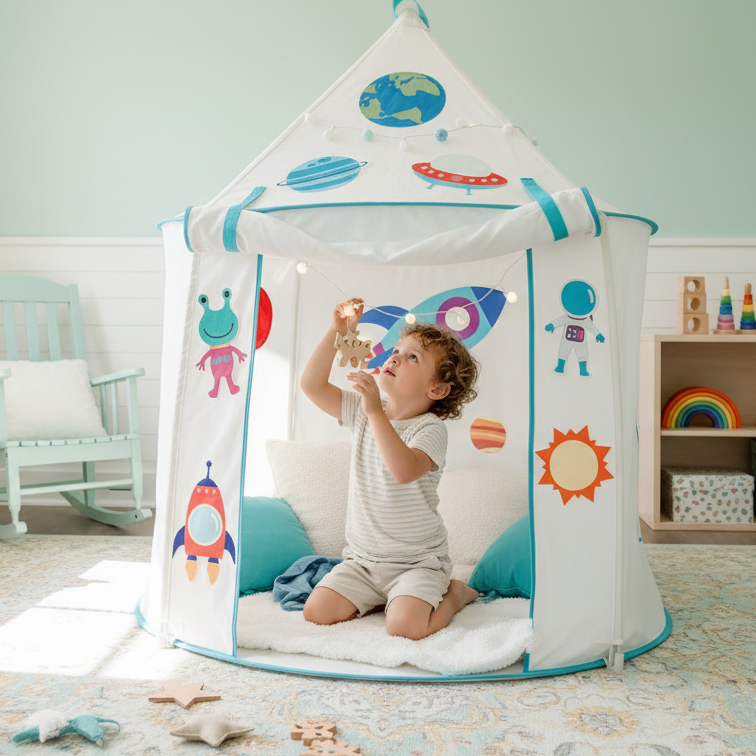
Many families exploring screen-free independent play for kids are turning toward flexible play spaces such as the customizable tents from ZeeZee Adventures. Rather than relying on flashing lights or electronic features, these spaces encourage children to become active participants in their own stories.
A child might spend one week exploring a Magical Kingdom.
The next week, that same space transforms into a Space Voyage mission.
The following month, it becomes a secret reading hideaway.
Because the themes can evolve with a child's interests, the experience remains fresh long after the initial excitement would typically fade.
Just as importantly, the enclosed design creates a quiet retreat that can help children feel calm, focused, and emotionally regulated.
For many families, this combination of imaginative flexibility and sensory-friendly design supports longer periods of independent play.
The beauty of open-ended play is that there is no script.
Children create the rules.
They direct the story.
They solve the problems.
And they discover that they don't need a screen to have an adventure.
Why the No Phone Summer Movement Is About More Than Screens
The growing popularity of No Phone Summer isn't really about technology.
It's about reclaiming childhood experiences that help children grow.
Parents aren't simply removing devices.
They're creating opportunities for:
-
Creativity
-
Independence
-
Resilience
-
Focus
-
Imagination
-
Family connection
When children spend more time building, pretending, reading, exploring, and inventing, they're developing skills that extend far beyond the summer months.
They're learning how to engage with the world around them.
They're learning how to play.
And perhaps most importantly, they're learning that boredom isn't something to fear.
It's often where the best adventures begin.
Conclusion
If you're considering a No Phone Summer, remember that success doesn't require becoming your child's full-time entertainer.
In fact, the opposite is often true.
Children thrive when they have the opportunity to create, imagine, and explore independently within a supportive environment. By reducing overstimulation and providing spaces designed for open-ended play, parents can help their children rediscover the joy of childhood beyond the screen.
The goal isn't perfection.
It's progress.
One afternoon of imaginative play, one cozy reading corner, and one screen-free adventure at a time.
Author Bio
The ZeeZee Play Experts are passionate advocates for child-led, imaginative play and healthy childhood development. Drawing from years of experience designing sensory-friendly, calming environments for children, our team helps families create meaningful opportunities for connection, creativity, and independent exploration. We believe every child deserves a space where imagination can thrive.






Comment (0)