
Why Defined Play Spaces Help Children Focus Longer
In many homes today, children are surrounded by opportunities for play. Toys are easily accessible, shelves are well stocked, and dedicated playrooms are often filled with colour, activity, and variety. Yet despite this abundance, parents frequently observe a familiar challenge: children struggle to stay focused during play.
Activities begin with enthusiasm but end quickly. Attention shifts from one toy to another. Engagement feels fragmented rather than sustained.
This raises an important question.
If children have more resources for play than ever before, why is it increasingly difficult for them to focus?
The answer lies not only in what children play with, but in where and how they play.
Defined play spaces—intentional, structured environments designed for focused play—are emerging as a powerful solution to this modern challenge.
The Nature of Attention in Early Childhood
To understand why defined play spaces matter, it is important to consider how attention develops in children.
Unlike adults, children are still learning how to regulate their focus. Their brains are highly responsive to external stimuli, and their ability to filter distractions is not yet fully developed. This means that the environment plays a significant role in shaping their behaviour.
When a child is placed in a space filled with competing visual and sensory inputs, their attention is naturally pulled in multiple directions. Bright colours, numerous toys, background noise, and constant movement all contribute to a fragmented experience.
In such environments, it is not that children are unwilling to focus. It is that the environment makes sustained focus more difficult.
The Problem with Undefined Play Areas
In many homes, play happens everywhere. Toys are spread across different rooms, stored in open bins, or left within easy reach at all times. While this approach provides convenience, it often lacks structure.
When play areas are undefined, children do not receive clear cues about where and how to engage. The boundary between play and other activities becomes blurred.
This lack of structure can lead to several challenges:
Children move quickly between activities without completing them.
They struggle to settle into a single task.
Their engagement becomes reactive rather than intentional.
Without a defined space, play becomes something that happens intermittently rather than something children fully enter into.
What Is a Defined Play Space?
A defined play space is not simply a designated area filled with toys. It is an environment that is intentionally designed to support focused, immersive play.
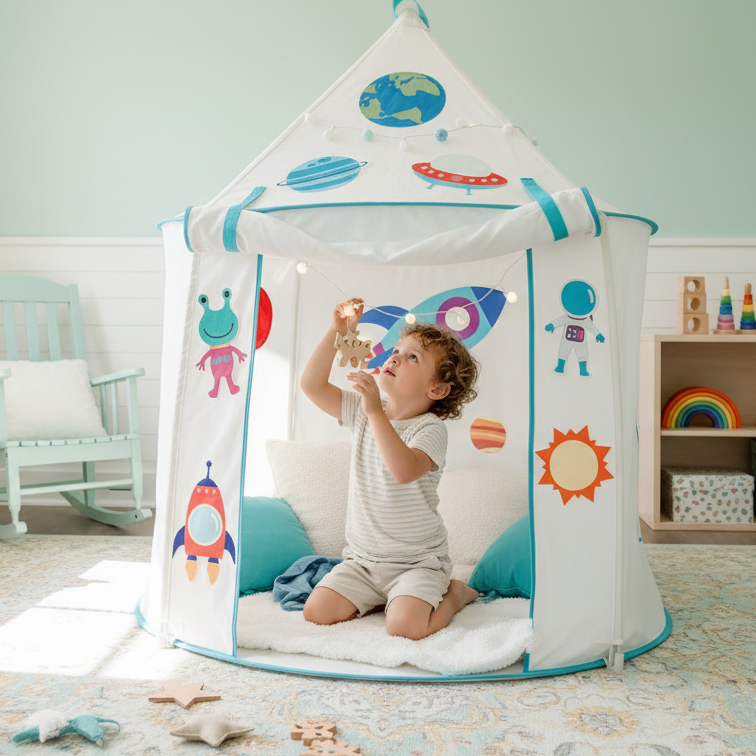
It may be a corner of a room, a small enclosed structure, or a carefully arranged section of a larger space. What distinguishes it is not its size, but its purpose.
A defined play space provides:
A clear boundary
A sense of separation from distractions
A consistent environment for play
A feeling of ownership for the child
These elements work together to create a psychological shift. When a child enters a defined play space, they are more likely to transition into a focused state of mind.
The Psychology of Boundaries
Boundaries play a crucial role in human behaviour, particularly in childhood. They provide structure, predictability, and a sense of safety.
In the context of play, boundaries help children understand where play begins and ends. They create a mental framework that supports engagement.
When a space is clearly defined, it signals to the child that this is a place for a specific type of activity. This reduces cognitive load, allowing the child to focus more fully on what they are doing.
In contrast, open and undefined environments require the brain to constantly process multiple inputs. This divides attention and reduces the depth of engagement.
Reduced Distraction, Increased Focus
One of the most significant benefits of defined play spaces is the reduction of distractions.
When a child is in a contained and intentional environment, there are fewer competing stimuli. This allows their attention to settle.
Instead of scanning the room for the next interesting object, the child remains engaged with what is already present.
This shift has a profound impact on the quality of play. Activities become more sustained, more detailed, and more meaningful.
The Role of Environmental Simplicity
Defined play spaces are often characterised by simplicity. They are not overloaded with toys or visual elements. Instead, they provide a calm and organised setting.
This simplicity is not a limitation. It is a deliberate design choice.
When the environment is less complex, the child’s mind becomes more active. Imagination fills the gaps, creating richer and more personalised experiences.
A simple space allows a single idea to develop fully, rather than being interrupted by constant novelty.
Immersion and the “Play State”
Children experience play most deeply when they enter a state of immersion. In this state, they become fully absorbed in their activity. Time seems to pass differently, and their focus becomes sustained and uninterrupted.
Defined play spaces support this state by removing external interruptions and providing a consistent environment.
Within such a space, a child can build a narrative, develop a scenario, and explore it without distraction. This leads to deeper engagement and more meaningful play experiences.
Emotional Security and Comfort
Another important aspect of defined play spaces is the sense of emotional security they provide.
Enclosed or semi-enclosed spaces often feel safe and comforting to children. They create a sense of control and ownership, allowing the child to engage without feeling exposed or overwhelmed.
This emotional comfort supports focus. When children feel secure, they are more likely to settle into activities and remain engaged for longer periods.
Spaces such as quiet corners or adaptable structures—like those created through ZeeZee Adventure—can serve as personal environments where children feel both safe and free to explore.
Supporting Independent Play
Defined play spaces also encourage independence.
When a child has a dedicated environment for play, they are more likely to initiate activities on their own. The space becomes associated with creativity and exploration, reducing the need for constant adult direction.
Over time, this fosters self-directed play, which is essential for developing confidence, problem-solving skills, and resilience.
Designing Effective Play Spaces at Home
Creating a defined play space does not require significant resources or large areas. What matters is intention.
Parents can begin by identifying a specific area within the home that can be dedicated to play. This space should be relatively free from distractions and visually distinct from other parts of the room.
The environment should include:
A limited number of open-ended play materials
Soft lighting or calming tones
Comfortable elements such as cushions or rugs
A sense of enclosure or boundary
Even a small adjustment can transform how a child interacts with their environment.
The Long-Term Benefits of Focused Play
When children are able to focus for longer periods, the benefits extend beyond play.
They develop stronger attention spans, improved problem-solving abilities, and greater emotional regulation. These skills are foundational for learning and development.
Focused play also encourages persistence. Children learn to stay with a task, work through challenges, and complete what they begin.
These are essential life skills that influence academic performance, social interactions, and overall well-being.
A Shift Towards Intentional Environments
As awareness grows, many families are rethinking how play is structured within the home.
The focus is shifting from providing more toys to creating better environments. Defined play spaces are becoming an integral part of this approach.
Rather than overwhelming children with options, these spaces provide clarity, structure, and opportunity.
Conclusion
Children do not struggle to focus because they lack interest in play.
They struggle because their environments often make focus difficult.
Defined play spaces offer a simple yet powerful solution. By creating environments that support attention, reduce distraction, and encourage immersion, parents can transform the way children engage with play.
Sometimes, the most effective change is not adding more—but defining what is already there.
Frequently Asked Questions
What is a defined play space?
A defined play space is a specific, intentionally designed area dedicated to play. It provides structure, reduces distractions, and helps children focus by creating clear boundaries between play and other activities.
Why do defined spaces improve focus in children?
Defined spaces reduce the number of stimuli a child must process. This allows their attention to settle on a single activity, leading to longer and more meaningful engagement.
Do children need a separate playroom?
No. A defined play space can be created within any room. Even a small corner, when designed intentionally, can provide the structure needed for focused play.
How do defined spaces support emotional development?
Defined spaces create a sense of security and ownership. This helps children feel comfortable and confident, which supports emotional regulation and sustained engagement.
Can play spaces reduce screen dependence?
Yes. When children have environments that support immersive play, they are more likely to engage in self-directed activities, reducing reliance on passive entertainment such as screens.
What role does ZeeZee Adventure play in defined play spaces?
ZeeZee Adventure can function as a flexible, defined play environment within the home. It provides a consistent structure while allowing children to adapt and transform the space based on their imagination, supporting both focus and creativity over time.





Comment (0)