

Why Defined Play Spaces Help Children Focus Longer
Why Defined Play Spaces Help Children Focus Longer
Introduction: The Challenge of Focus in Modern Childhood
In today’s homes, children are surrounded by stimulation. Toys are abundant, colours are vivid, and digital devices compete for attention. While this environment may appear engaging, it often creates an unexpected challenge: difficulty sustaining focus.
Many parents notice a common pattern. A child begins playing with enthusiasm but quickly shifts from one activity to another. Attention becomes fragmented. Play feels restless rather than immersive.
It is easy to assume this is simply how children behave. However, research in child development and environmental psychology suggests a different perspective.
Children are not naturally unfocused. Rather, their ability to concentrate is deeply influenced by the environments in which they play.
One of the most powerful yet often overlooked factors in supporting attention is the presence of defined play spaces.
What Is a Defined Play Space?
A defined play space is an area that is intentionally structured to support focused, meaningful play.
Unlike open, scattered environments where toys are spread across a room, a defined space provides:
- clear physical boundaries
- a sense of enclosure or separation
- limited and intentional stimuli
- a consistent place associated with play
These spaces do not need to be large or complex. In many cases, the most effective play environments are small, simple, and thoughtfully arranged.
Examples include:
- a reading corner with cushions and soft lighting
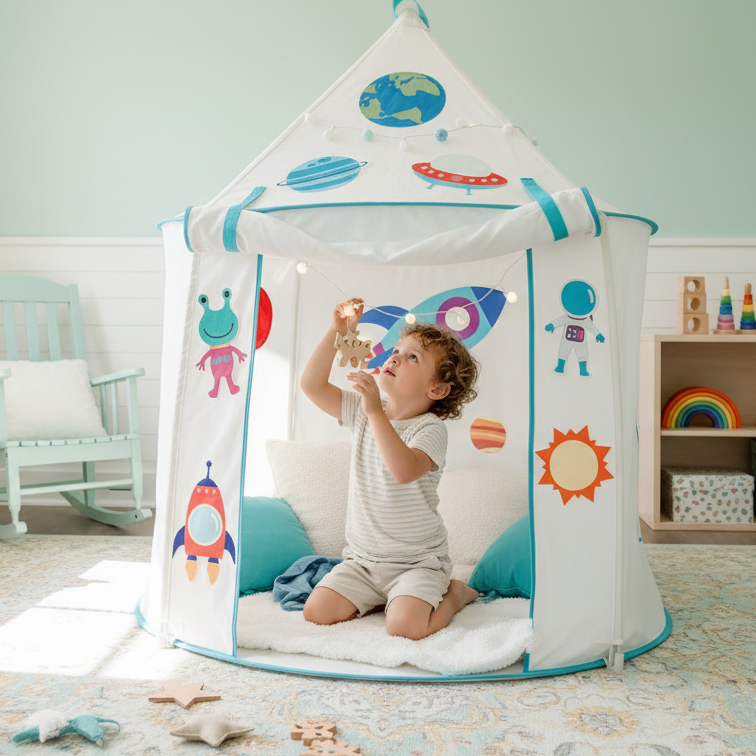
- a small play tent or enclosed nook
- a designated floor area with carefully selected toys
- a quiet corner separated from the main living space
The defining feature is not size, but structure.
The Science of Attention in Children
To understand why defined spaces matter, it is important to consider how attention develops in early childhood.
Young children are still learning to regulate their focus. Their brains are highly responsive to sensory input, meaning:
- new stimuli easily capture attention
- distractions are harder to filter out
- sustained concentration requires environmental support
This is often described in psychology as limited attentional control.
When a child is placed in a highly stimulating environment—filled with noise, movement, and visual clutter—the brain must constantly process competing signals. As a result, attention becomes fragmented.
In contrast, environments that reduce unnecessary input allow children to:
- maintain focus for longer periods
- engage more deeply in activities
- transition into states of immersive play
Why Boundaries Improve Focus
Defined play spaces introduce something crucial: boundaries.
These boundaries can be physical (walls, furniture, tents) or visual (rugs, lighting, arrangement). Regardless of form, they create a psychological effect.
Boundaries help children understand:
“This is where play happens.”
This clarity reduces cognitive load. Instead of constantly scanning their environment, children can direct their attention inward, towards their activity.
Benefits include:
- reduced distractions
- improved task persistence
- increased sense of control
- clearer transitions between activities
The Role of Enclosure and Security
There is also an emotional component to defined spaces.
Enclosed or semi-enclosed environments—such as small play tents or cosy corners—can create a sense of safety and comfort.
This feeling of security supports focus in several ways:
- children feel less exposed to external interruptions
- overstimulation is reduced
- the environment feels predictable and controlled
In practice, many modern play designs—such as modular tent-based environments like ZeeZee Adventures—are built around this principle of combining enclosure with flexibility, allowing children to feel secure while still shaping their own play experience.
Reducing Sensory Overload
Modern play environments often contain excessive sensory input:
- bright colours
- loud toys
- overlapping activities
- digital distractions
While stimulation is important, too much can overwhelm the developing brain.
Defined play spaces act as a filter.
By limiting:
- the number of toys available
- the intensity of colours and sounds
- the visual complexity of the environment
These spaces help children regulate sensory input more effectively.
The result is not less play—but deeper engagement.
Encouraging Deep, Sustained Play
When distractions are reduced and boundaries are clear, children are more likely to enter sustained play states.
This type of play is characterised by:
- longer periods of concentration
- more complex storytelling
- repeated exploration of ideas
- increased problem-solving
Instead of quickly moving between activities, children remain engaged.
This is where open-ended environments become particularly valuable. Flexible systems—such as adaptable play setups like ZeeZee Adventures—can support evolving play scenarios without introducing new distractions, helping children stay immersed for longer periods.
Defined Spaces and Imagination
Creativity does not require constant stimulation. It requires space.
Defined play environments support imagination by:
- reducing external noise
- creating a sense of “world-building.”
- allowing children to take ownership of their surroundings
Within a contained environment, children are more likely to:
- invent narratives
- role-play scenarios
- experiment with ideas
The space itself becomes part of the story.
The Connection Between Environment and Emotional Regulation
Focus is closely linked to emotional state.
Children who feel overwhelmed often struggle to concentrate.
Defined play spaces support emotional regulation by:
- providing a calming environment
- offering a retreat from busy surroundings
- creating a predictable space for self-directed activity
Over time, children begin to associate the space with calmness and focus.
Practical Ways to Create a Defined Play Space
Parents do not need elaborate setups to create effective play environments.
Simple adjustments can make a meaningful difference.
1. Create Physical Boundaries
- Use rugs, furniture, or small enclosures
2. Limit Available Toys
- Rotate toys to reduce overwhelm
3. Use Calm Visual Elements
- Choose soft tones and minimal decoration
4. Introduce Soft Lighting
- Warm lighting encourages relaxation
5. Encourage Ownership
- Allow children to personalise their space
6. Consider Flexible Structures
- Modular elements—such as enclosed play tents or adaptable environments—can help maintain both structure and creative freedom over time
A Shift in How We Think About Play
Many families focus on acquiring more toys.
However, research increasingly suggests that environment matters more than quantity.
A thoughtfully designed play space can transform how children interact with even the simplest objects.
Instead of asking:
“What should we buy next?”
it may be more valuable to ask:
“How can we create a space that supports focus and imagination?”
Conclusion: The Power of Intentional Space
Defined play spaces are not about restriction.
They are about clarity.
They provide children with:
- structure without limitation
- calm without boredom
- boundaries without constraint
In a world filled with distractions, these spaces offer something increasingly valuable:
The ability to focus.
And within that focus, children discover something even more important—
the freedom to think, imagine, and create.
Frequently Asked Questions
Why do defined play spaces improve focus?
They reduce distractions, limit sensory input, and create clear boundaries that support sustained attention.
Do children need large playrooms?
No. Smaller, well-defined spaces are often more effective for focus.
What type of play environment works best?
Environments that combine structure with flexibility—such as enclosed or modular play spaces—tend to support both focus and creativity.
How can parents improve focus without buying more toys?
By simplifying the environment, reducing clutter, and creating a defined area designed for calm, uninterrupted play.





Comment (0)