
Why Kids Get Bored With Toys So Quickly (And What Actually Keeps Them Engaged)
You buy a new toy for your child.
At first, it’s magical.
Excitement.
Curiosity.
Hours of play.
But within a few weeks, something changes.
The toy sits in the corner.
The excitement fades.
Your child moves on.
Many parents assume this is simply part of childhood — kids always want something new.
But research into play behavior tells a different story.
Children don’t necessarily get bored because they need more toys.
Often, they get bored because they need more possibilities.
The Surprising Research on Toy Boredom
Studies in child development have shown that children often lose interest in toys relatively quickly — sometimes within a few weeks — especially when the toy has a single fixed function.
ZeeZee - brand & origin launch …
Why does this happen?
Because many toys are designed to do one thing.
-
A toy car drives.
-
A puzzle has one solution.
-
A themed toy tells one story.
Once the child has explored that function, the novelty disappears.
Psychologists call this novelty decay — when the excitement of something new fades after repeated exposure.
Children naturally seek new stimulation and challenges, which is why they quickly move on from toys that stop offering new experiences.
More Toys Don’t Always Solve the Problem
When kids lose interest in toys, the instinct is often to buy more.
But research suggests the opposite approach may actually be better.
A well-known study published in the journal Infant Behavior and Development found that children played longer and more creatively when they were given fewer toys.
When fewer toys were available:
-
children explored each toy more deeply
-
they invented new ways to use them
-
Their play became more imaginative
In contrast, environments filled with many toys often led to shorter play sessions and reduced creativity.
The reason is simple:
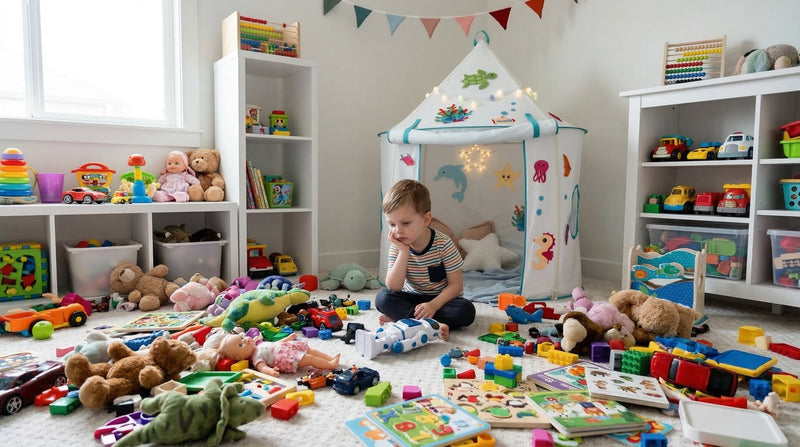
Too many options can overwhelm attention.
Instead of diving deeply into play, children jump from toy to toy.
Why Open-Ended Play Changes Everything
The most engaging toys share one important quality:
They don’t tell children how to play.
They simply invite play.
Child development experts call these open-ended toys — toys that can become many different things depending on the child’s imagination.
For example:
-
building blocks
-
play tents
-
dolls or figurines
-
craft materials
-
pretend play objects
These toys don’t have a fixed storyline.
Instead, children create their own.
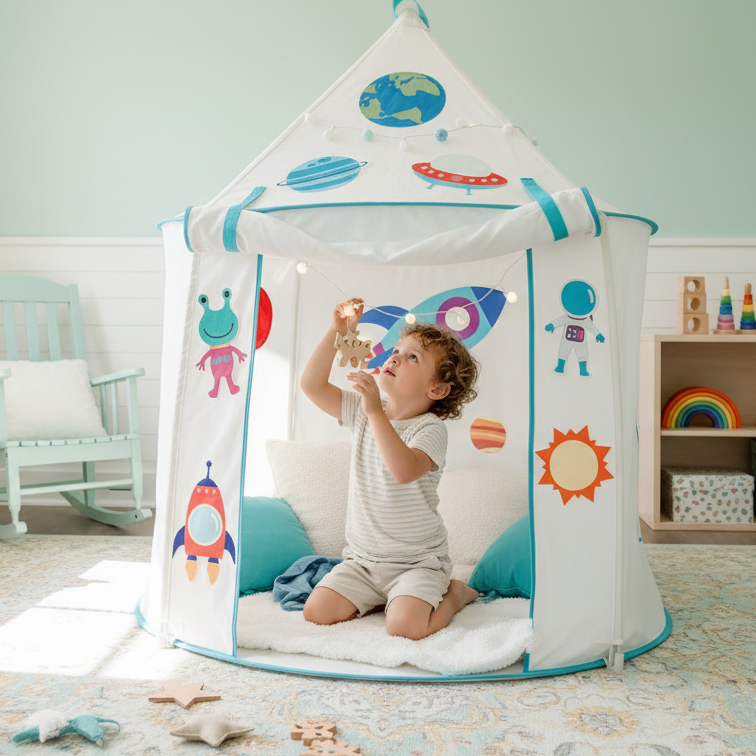
One day a tent becomes a rocket ship.
The next day, it’s a pirate cave.
The day after that it becomes a quiet reading nook.
Because the possibilities are endless, the play never gets stale.
Imagination Is the Real Engine of Play
When children lead their own play experiences, something powerful happens.
They develop skills that go far beyond entertainment.
Research shows imaginative play helps children build:
-
problem-solving skills
-
creativity
-
emotional regulation
-
language and storytelling abilities
This kind of play is especially powerful because it requires children to actively shape their world rather than simply react to it.
Instead of pressing buttons or following instructions, they become creators of stories and adventures.
Why Flexible Play Environments Work Better
Another important insight from developmental psychology is that the environment matters just as much as toys.
Children play longer when they have spaces that support exploration and imagination.
These environments usually include:
-
cozy corners
-
simple structures
-
open-ended materials
-
calm surroundings that encourage focus
Spaces like reading nooks, forts, or small play tents often become powerful imaginative environments because they feel like a world of their own.
Children can step inside and transform the space into anything their imagination creates.
A Different Way to Think About Playtime
Instead of asking:
“What new toy should we buy?”
Many parents are starting to ask a better question:
“What kind of play experience encourages creativity?”
The answer often isn’t about adding more toys.
It’s about creating opportunities for:
-
storytelling
-
exploration
-
imagination
-
quiet focus
When children have the freedom to invent their own worlds, play becomes richer and more meaningful.
And suddenly the same toy or space can spark adventures for months or even years.
The Kind of Play That Stays Interesting
Children rarely get bored with toys that grow with them.
The toys that last the longest are the ones that leave room for imagination.
They aren’t finished products.
They’re starting points.
A castle waiting for a story.
A cave waiting for explorers.
A spaceship waiting for launch.
And when children are free to invent those stories themselves, something amazing happens.
Play never really runs out.
Frequently Asked Questions
Why do kids get bored with toys so quickly?
Children often lose interest in toys when the toy has a fixed purpose or limited ways to play. Once the novelty fades, the toy no longer challenges their imagination.
How many toys should a child have?
Research suggests fewer toys can actually improve play quality because children explore them more deeply instead of jumping between many options.
What are open-ended toys?
Open-ended toys are toys that can be used in many ways. Examples include building blocks, art supplies, and imaginative play spaces.
What kind of toys keep children engaged the longest?
Toys that encourage creativity, storytelling, and imagination tend to hold children's interest the longest because they evolve as children grow.
Research References
Research and insights referenced in this article include studies on:
-
Novelty and toy engagement in early childhood
-
open-ended play and imagination development
-
attention and toy quantity in play environments
Evidence also shows children often lose interest in toys quickly when play experiences become repetitive or limited.




Comment (0)